
Advances in SiC Technology for Electric Vehicles
Why SiC MOSFETs suit EV traction inverters, on-board chargers and 800 V systems, plus gate drive, layout and sourcing points engineers need to consider.
- EV
- Silicon Carbide
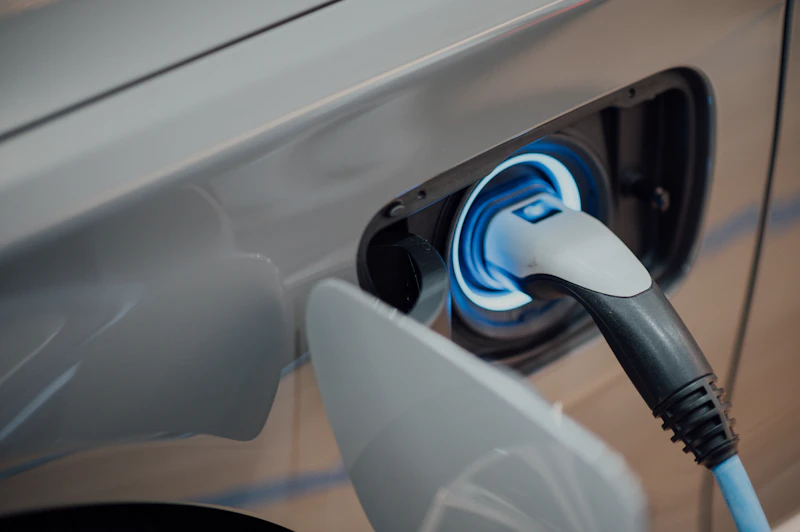
Silicon carbide (SiC) power semiconductors have moved from niche use to mainstream adoption in electric vehicle (EV) power electronics. Traction inverters, on-board chargers, and high-voltage DC-DC converters increasingly use SiC MOSFETs in place of silicon IGBTs or silicon MOSFETs. Understanding why SiC performs differently, and what it demands from the surrounding circuit, helps engineers design reliable systems and helps buyers evaluate parts that are not always direct drop-in replacements.
Why Silicon Carbide
SiC is a wide-bandgap semiconductor. Compared with silicon, it has a wider bandgap, a much higher critical electric field, and better thermal conductivity. These material properties lead to several practical advantages:
- Higher voltage capability in thinner drift layers: devices rated for 650 V, 1200 V, and higher can achieve lower on-resistance for a given die area.
- Fast, low-loss switching: SiC MOSFETs are majority-carrier devices without the tail current of IGBTs, so switching losses are lower and higher switching frequencies are practical.
- High-temperature operation: the material tolerates higher junction temperatures, although the package and gate oxide usually set the practical limit.
- Better heat spreading: higher thermal conductivity helps move heat out of the die.
In an EV, these properties can translate into higher inverter efficiency, especially at partial load where vehicles spend much of their time, as well as smaller cooling systems and passive components.
The Role of 800 V Architectures
Many newer EV platforms use battery systems around 800 V instead of 400 V. At the same power, higher voltage means lower current, which reduces conduction losses in cables and allows faster DC charging without excessively thick conductors. Silicon IGBTs rated for 1200 V are available, but their switching losses rise at higher voltages and frequencies. 1200 V SiC MOSFETs are well suited to 800 V systems, which is one reason SiC adoption and the move to higher battery voltage have progressed together.
Key Applications in the Vehicle
Traction inverter
The traction inverter converts battery DC to three-phase AC for the motor. It is the highest-power converter in the vehicle and the place where efficiency gains have the largest effect on range. SiC is commonly used here in power modules or as parallel discrete devices.
On-board charger
On-board chargers (OBCs) convert grid AC to battery DC. Higher switching frequency allows smaller magnetics, and SiC devices support topologies such as totem-pole PFC and bidirectional designs that enable vehicle-to-load or vehicle-to-grid functions.
High-voltage DC-DC converter
This converter steps the traction battery voltage down to the low-voltage bus. SiC on the high-voltage side can improve efficiency and power density.
Recent Technology Directions
SiC device and manufacturing technology continue to develop along several lines:
- Trench MOSFET structures: in addition to planar designs, trench gates can reduce specific on-resistance, with manufacturers using different approaches to manage electric field stress at the gate.
- Larger wafers: the industry has been transitioning from 150 mm toward 200 mm SiC wafers, which is expected to improve cost and capacity over time.
- Advanced packaging: silver sintering, improved substrates, and low-inductance module layouts help take advantage of fast switching and high temperature capability.
- Improved gate oxide reliability: manufacturers have worked to reduce threshold voltage drift and improve long-term stability under gate stress.
ST, for example, offers SiC MOSFETs in its STPOWER portfolio, including automotive-grade discretes and ACEPACK DRIVE power modules intended for traction inverters.
Gate Drive Requirements
SiC MOSFETs are not simply faster silicon MOSFETs. Their gate drive needs specific attention:
- Gate voltage levels: many SiC MOSFETs are specified for a positive gate voltage higher than typical silicon MOSFETs and benefit from a negative turn-off voltage to prevent false turn-on. Recommended values differ by manufacturer and generation, so always follow the datasheet.
- High dv/dt immunity: fast switching edges require isolated gate drivers with high common-mode transient immunity (CMTI).
- Short-circuit protection: SiC dies are small and typically have a shorter short-circuit withstand time than IGBTs, so desaturation or overcurrent detection must respond quickly.
- Miller clamp: an active Miller clamp helps hold the gate off during fast transitions on the opposite switch.
Isolated gate drivers aimed at SiC include TI's UCC21750 and UCC5870-Q1, ST's STGAP family including the STGAP2SiC, and NXP's GD3160. These integrate features such as desaturation detection, soft turn-off, and diagnostics; the exact feature set varies by device.
Layout and EMI
Faster switching edges increase the impact of parasitic inductance and capacitance. Minimizing the commutation loop, using Kelvin source connections where available, and designing low-inductance DC-link busbars are important to limit overshoot and ringing. Higher dv/dt also increases common-mode currents through motor windings and heatsinks, so EMI filtering and bearing current mitigation should be considered at the system level.
Sourcing Considerations
SiC devices from different manufacturers vary in recommended gate voltage, threshold, on-resistance temperature coefficient, body diode behavior, and package pinout. A replacement part with the same voltage and current rating may still require gate drive changes or requalification. Buyers should confirm AEC-Q101 qualification for discretes, review long-term availability, and involve design engineers before approving alternatives.
Summary
SiC technology enables more efficient, compact, and higher-voltage EV power electronics, particularly in traction inverters, on-board chargers, and DC-DC converters. Realizing those benefits depends on appropriate gate drivers, careful layout, and attention to device-specific characteristics.
XINJIEDA can help source SiC MOSFETs, gate drivers, and related power components from ST, TI, and NXP, or review a BOM for availability and alternatives.